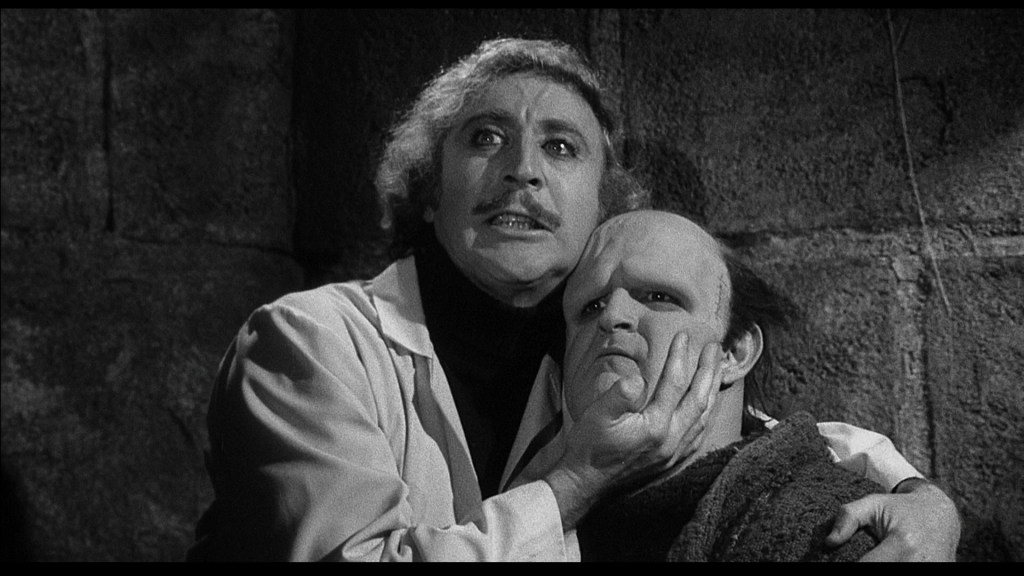
I was on the phone with my mom last night after a couple of strawberry margaritas, and I could hear that she had Young Frankenstein on in the background. The movie plot had progressed to that part where Dr. Frankenstein is starting to accept the monster he created in his lab and is beginning to show him love. He says to the Monster:
Hello handsome. You’re a good looking fellow, do you know that? People laugh at you, people hate you, but why do they hate you? Because… they are jealous. Look at that boyish face. Look at that sweet smile. Do you wanna talk about physical strength? Do you want to talk about sheer muscle? Do you want to talk about the Olympian ideal? You are a God. And listen to me, you are not evil. You… are… good.This is a nice boy. This is a good boy. This is a mother’s angel. And I want the world to know once and for all, and without any shame, that we love him. I’m going to teach you. I’m going to show you how to walk, how to speak, how to move, how to think. Together, you and I are going to make the greatest single contribution to science since the creation of fire.
You are good. These words cause the Monster to dissolve into tears as Dr. Frankenstein pulls him into a hug. To a monster who has no companions, no history, no structured upbringing with complete with clear pictures of right and wrong and unconditional love through it all, hearing the words You…are…good must have been a powerful signal of acceptance and trust. Last night when I heard that line, my drunk little ass kept my mom entertained for about an hour shouting “YOU ARE GOOD” into her ear on the phone and going on and on about how that’s all anyone on planet earth really wants to hear. We all just want some confirmation that we are accepted and that someone on this giant planet thinks that we – that is, our being, our existence, the space we take up on this land – are good. In a world where so many things are bad, and so many unfortunate events happen, and you encounter so many people who let you down all the time with their human ways (while you are busy letting them down too) – how lovely it is when someone who is swimming through the exact same shit-pile that you are looks at you and says YOU ARE GOOD. You are a gruesome, disfigured, delayed, confused Monster, and yet, you are good.
I’ve been blessed my entire life with people who look at the little monster that I am and tell me that I am still good. I have one friend who randomly texts me words of encouragement when I’m least expecting it. I have friends and family who offer me good advice and bad advice and patience when I ultimately ignore their advice, and know the truth about every ugly, bitter, angry part of me and still tell me I am loved and deserving. And they don’t say it because they know I need to hear it – they say it because they believe it. They believe I am good – that all the lovely, thoughtful and kind things I do and say somehow outweigh my mistakes. They all listen to me tell stories where I am sometimes the hero, other times the villain, or other times the willing victim or bystander who gets in the way – and no matter which role I fill; antagonist, protagonist, annoying pest or comic relief character – they still tell me I am good.
If you are reading this today, I just want you to know that you are good. I don’t know why – some of my readers are complete strangers. But if you want to know why, just ask your friends, significant others or family and they’ll be able to tell you. And then you be sure to tell them all the reasons they are good. It seems trivial – something so simple that Frankenstein’s simple-minded monster understood it perfectly, but you have no idea who needs to hear it today or might need to hear it tomorrow, or the next day. Grab all of the monsters in your life that you believe are good and tell them that they are.
Miss Maudie Atkinson is a secondary character from the novel To Kill a Mockingbird. She lives across the street from the protagonists of the book, the Finch family – Atticus, Jem and Scout. The book chronicles the adventures of 5-year-old Scout and her older brother, Jem -two rambunctious, imaginative children who live in Maycomb, Alabama during the Great Depression. Maycomb is a sleepy little town, eventually rocked wide awake by a racially-charged trial of a black man for the alleged rape of a young, white woman. The children find themselves in the middle of town drama when their wise and authentic father, Atticus is selected to defend Tom Robinson (the accused rapist) in court. They also find themselves intrigued (or borderline obsessed) with the town recluse, Boo Radley. As the children navigate hot, sticky summers in Maycomb, full of child and adult drama alike, they have a constant companion in Miss Maudie. Miss Maudie Atkinson is spunky, clever, ladylike, gentle, and persevering – and she treats Scout and Jem like adults. She shows them respect and guides them as they deal with some themes that may be deemed beyond the grasp of their growing minds by other adults. Instead of telling them to be quiet and to stop asking questions, she answers their questions as blatantly and openly as she would for any adult. She is a true friend to Jem and Scout, and perhaps their greatest example of a mother-figure they have in their lives.
Miss Maudie Atkinson is my favorite literary character I’ve encountered (so far). I wish I emulated Miss Maudie a little more. When she speaks in the book, her words are dripping with class and wisdom. Her demeanor is dignified, even in the face of great suffering (like when her house catches on fire). She is funny and empathetic, and shows respect to everyone she meets. She is this wonderful example of how you can have a potent impact on the people around you, even in the most mundane situations (tea parties, porch sitting, etc.), and she demonstrates to young Scout that you can be ladylike without squashing every ounce of “self” and expression within you. She is lovely and strong, and I so desperately want to be lovely and strong too.
I like to think that Miss Maudie (the dog) lives up to some of the traits of her namesake. She is certainly spunky and gentle, and treats most people with respect. She is definitely prejudiced against large humans in dark clothing – especially after dark. She is clever, but also very dumb. She is not well-trained, but she has done an excellent job training me – most notable when the pizza has been delivered or the steaks are done cooking. Like Miss Maudie in the book, she has also survived a house-fire. She loves children. She can’t be trusted at tea parties because she will probably break some of the fine china or pee on the parlor rug. She is not a great conversationalist, but she’s funny. She’s barks at every noise she hears, and is the loudest chewer on the planet. She has torn a hole in every fuzzy blanket I own. She throws up at the most inconvenient times, and rattles her crate at bedtime as if I’ve locked her in Guantanamo for life. She looks adorable in bandanas, and hates to have her hair brushed. She’s a great listener. Miss Maudie (the dog) has a potent impact on my life every day, and she helps me be strong.
A lot of the guilt I experience in my life is related to Maudie Dog. I worry about her a lot. Is she happy? Does she get enough walks? Does she know how much I love her? Does she look at me and think about that time I smacked her – that time, I was late for work and she wouldn’t come out from under the bed and I lost my temper, and cried the entire way to work out of shame? Does she suffer from my demanding career? Did I mess up the good thing she had going for her when me and her “dad” parted ways? Would she have been happier with him?
I can remember when I first brought her home. This poor little puppy missed her real mom so much she cried all night every night for the first week we had her. I slept on the floor with her back then. I would lay down with my pillow and blanket in the closet next to her tiny little crate, and stick my hand inside it so she could feel me next to her all night. One night, I woke up and she was not in her crate. I sat up in a panic, and then looked down at my legs to see that she had curled up behind my knees and was sleeping like an angel. I felt like such a good dog mom in that moment. I felt like I had been her comfort during this incredibly painful time for her, and that I enveloped her with love. I think she’s been returning the favor ever since.
Like the rest of you, I have experience sitting in those valleys of life that people always talk about- those tiny, personal atomic bombs I mentioned in a previous entry. I don’t know how our pets are so attune to our feelings, but during these times, Maudie has presented herself front and center in the storm as if she knows every pathway in my heart and wants to walk them all with me. More than once in my life, I have fallen asleep with tears in my eyes and Maudie on my feet. Once when I was sad and working from home, she put her paw on my hand and rested it there – and there we sat for several minutes just holding each other. I am always so shocked by these little moments with her. She is this unstoppable ball of energy, always bouncing off the walls, begging for a fetch or a walk or a bite of something yummy. Yet, when my heart breaks, she is still. She looks at me with her big brown eyes, and together we are still.
I know some of you may read this and think that I need to get a grip or a life- that an animal shouldn’t inspire so much prose or sentimental foolishness. But I know that Maudie and I have survived a lot of trials together. We lived through a pandemic, we survived a fire. She has been by my side through migraines, strep throat, sore knees, and broken hearts. She lets me dress her up every Halloween, endures ugly Christmas sweaters, agonizing 5k races and trips to the groomer. She is always up for a hike or a walk, or even just a long ride in the car. She slow dances with me when I’m lonely. She gives me a reason to get out of bed every morning (her whines are quite persuasive) and makes me leave the house to get fresh air at least three times a day. Choosing to take care of her for the rest of her life was the best decision I ever made. More lovely still, she chooses to take care of me even when I’m not worthy or deserving of her unconditional love. I am not always lovely and strong like Miss Maudie Atkinson, but sometimes I think Maudie Dog helps me be lovely and strong more often because she is lovely and strong.
My 8th grade Arts and Humanities teacher, an eccentric lady named Ms. Williams, was purely luminescent – that’s the best way to describe her. She lit up every room she was in with her energy and quirky expressive style. When I think back on the lessons from my school years that I remember most vividly – most of those memories come from her class. I can remember reciting Hamlet in front of my classmates, learning a pop dance number of “Everybody” by the Backstreet boys, receiving the “Stephen Meeks Award for Scholarly Achievement” during a unit on the Dead Poets Society, and participating in a week-long Holocaust demonstration where half of the class was treated differently than the other half for no reason at all – one kid ended up having an actual meltdown during this unit, and I don’t think I’ll ever forget Ms. Williams calmly walking the red-faced, tearful boy out of the room. We played improv acting games, and I even got to be a defense lawyer in the trial in which Scar was prosecuted for the murder of Mufasa in The Lion King. Ms. Williams had a poster of John Lennon in the back of her classroom.
I was always pretty sure that she didn’t like me very much. Not that I was a bad seed, or caused her any problems, or ever had any type of altercation with her. I was a very strait-laced, diligent bookworm in school (not unlike Stephen Meeks), and a good rule of thumb was that I was destined to have the most trouble in classes that didn’t have an assigned textbook. The only B I got in high school was in art class, ya know what I mean? I totally get how a creative person like Ms. Williams might have been taxed by a child like me. I spent much of my time in her class feeling really uncomfortable – feeling eyes on me while I made up a rap on the spot during an improv game, or getting frustrated while trying to get the kid who was playing Scar in our courtroom drama to pay enough attention to his defense to be convincing on the stand. Looking back, I learned so much from Ms. William about how art can make you feel – and how vulnerable you are when you share your art with the world. I felt nervous in her class because creative expression can be uncomfortable, especially when others are looking/listening/reading. I learned that creating art is not something reserved for the beautiful and talented – even self-conscious teens in sweatpants can create art, and everyone can appreciate it (duh, didn’t we all download the new Adele song at the exact same time last week?!) Maybe this blog and vulnerability I experience every time I hit that “Publish” button is a living, breathing tribute to Ms. Williams and the other great teachers that taught me to use this dusty, clumsy, non-math part of my brain (I’m looking at you, Mrs. Long and Mr. Graham). These excellent educators taught me how to love stories and the ways that good stories that can be told through all of the various art forms. I’m a sucker for a good story.
I always think of Ms. Williams this time of year because she loves (trying not to use the past tense too much here, because I am pretty sure she’s still alive!) scary movies. She had an entire unit on scary movies in our class, and would show us clips from her favorite horror films. We watched the Twilight Zone segment (I think it was from the Twilight Zone movie – starring Dan Aykroyd) where there was a monster on the wing of the airplane, and I still can’t take a flight without thinking about it. She used to turn out the lights in the classroom and hold a flashlight up to her face while she told us scary campfire stories. She told the story about the babysitter getting phone calls from the murderer inside the house, and a story about an old woman putting a puzzle together, and slowly learning that the picture in the puzzle shows her in her house putting together a puzzle – and the last piece reveals that there’s a man with a knife standing behind her. EEK! She once told me that in order to really watch a scary movie correctly, you should turn all the lights out in the house and open all of the doors and windows for full effect. I’m more of a watch-in-broad-daylight-with-a-friend-with-all-lights-on-and-doors-locked-and-SimpliSafe-armed kind of scary movie connoisseur, but I can understand where she’s coming from with this suggestion. In addition to all the other great things I learned in Ms. Williams’ class, I also learned that it’s really fun to be scared!
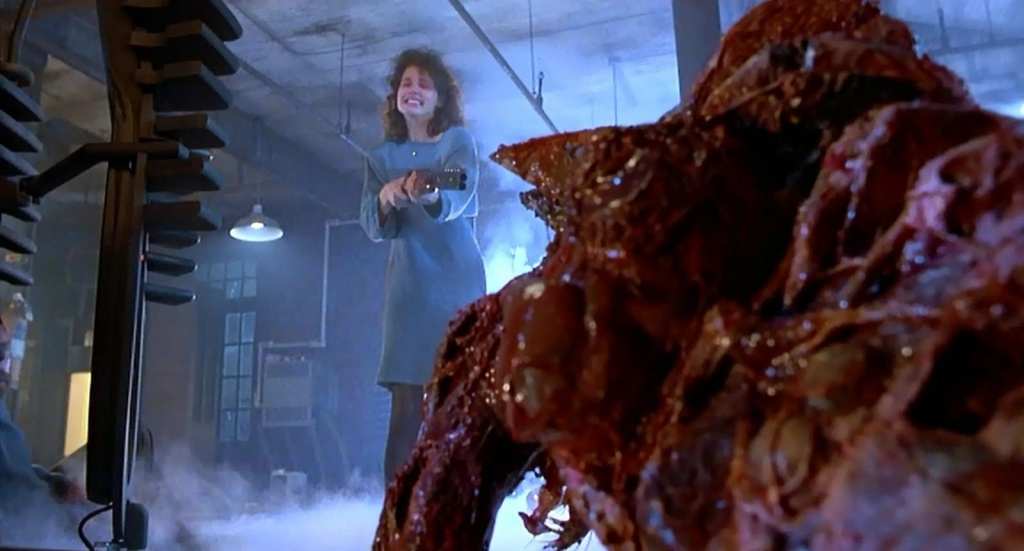
I have a long history of being a baby about scary movies. I watched Signs with my dad the year it came out, and it gave me nightmares for many days afterward. When fellow freshman girls at WKU asked me to go see Haunting in Connecticut, I ended up sleeping on the concrete floor in their dorm-room that night because my roommate wasn’t home and I couldn’t be alone. Huge baby. I also take these scary stories and carry them around with me. I remember the end of I Know What You Did Last Summer featured a scary guy with a hook thing grabbing Sarah Michelle Gellar’s feet while she was sitting on her bed. I only recently stopped checking under my bed before I go to sleep, and that’s because my bed is so low to the ground that Maudie can’t even get under there to tear up my carpet (much to her puppy dismay). I am also convinced that I think about The Fly more than anyone else on the planet – more than the writer, the actors, the director, everyone. I think about it way too much, and feel so much compassion for Jeff Goldblum and his grotesque fly body, and Geena Davis’ plight of having to shoot fly-man Jeff Goldblum in the face before having his maggot baby. The end of that movie might be the greatest contraception advertisement of all time.
As I get older, I’m noticing that scary movies are less scary than they used to be, and I think it has something to do with my true crime obsession. It seems like every day I’m listening to some sort of murder podcast. I like to think I was a fan of My Favorite Murder before it was cool, and I’ve seen Karen and Georgia perform live twice. If you aren’t familiar with the podcast, it is a comedy podcast about true crime where Karen Kilgariff and Georgia Hardstark each tell a true murder story each week. Comedy and murder is such an interesting combination, but it really works – they tell stories and laugh a lot, while still showing respect and compassion for victims. On Mondays, they release mini-episodes where they read the emails they receive from their fans about hometown murders. This is the part that is mind-boggling. It seems like everyone has their own story of a murder or creepy story that happened to someone they know. It’s as if every person is one or two degrees of separation from some violent tragedy.
My Favorite Murder ended up being a gateway drug to other sorts of true crime media – other podcasts such as Last Podcast on the Left, True Crime Garage, Crime Junkies, Sword and Scale; tv shows and documentaries galore, and books. Karen’s friend, Michelle McNamara passed away before she could complete her book about the Golden State Killer. McNamara was the author of a popular true crime blog, and devoted the last years of her life to finding the identity of California’s East Area Rapist (EAR), the Original Night Stalker – one person with a lengthy and varied crime portfolio. This man ransacked homes, peeped in the windows of young girls, raped women (sometimes making their husbands watch) and eventually murdered at least 13 people. McNamara dubbed him the Golden State Killer, and spent years interviewing victims, victims’ families, and investigators (current and former). When she died, her husband, Patton Oswald and her assistant, Billy Jensen worked to complete the book in her absence. I’ll Be Gone in the Dark: One Woman’s Obsessive Search for the Golden State Killer was released in February of 2018. The Golden State Killer, Joseph DeAngelo was arrested two months later. I was fascinated by the timing of these events, and felt so happy for Michelle and her family. She wasn’t able to find this guy on her own, but the timely release of a book filled with victim stories and the complex sentiments of survivors, as well as the horrifying details of the crimes was so appropriate and perfect. Her book is by far the scariest thing I’ve ever read, and I can’t fall asleep listening to the audio book because I will dream about the baby-faced killer hiding in the dark. If you haven’t read it, I really recommend it – the audiobook is narrated by my favorite narrator, Gabra Zackman.
My true crime obsession is not unique. It seems like crime has been popular for decades, even centuries (NYPD Blue, Law and Order, every movie on Lifetime, JonBenet Ramsey headlines, the OJ Simpson trial, In Cold Blood, Lizzie Borden). The triumphant return of radio in the form of podcasts created a new space where storytelling was once again limited to sound – no special effects, 3D, costumes, etc. When Sarah Koenig released Serial in 2014, she reminded us all how effective good storytelling can be when it is just that – someone using their own voice to tell a story from start to finish. It is such a simple concept, but over the years podcasters all over the world have tried to follow in Koenig’s footsteps to masterfully create audio-media that is as compelling and unique as any movie or tv show (across all genres, not just true crime) – and so many have succeeded.
I’ve lived alone (sans other humans) for much of my life, and I’m a small person with less upper body strength than most. It’s impossible to hear these true crime stories about women being raped and murdered and not map those events onto my own life. It’s too easy to turn scary true stories into possibilities. I guess that’s why the stories that scare me the most are the ones about women whose lives mirror mine in some way. When I first moved to the DC area, there was a news headline about a woman who was going for a run around 7 pm in Dupont Circle, who was stabbed in the street. She crawled into a Chinese restaurant, and died there – for no reason – she wasn’t robbed or raped, just stabbed and left to die. I know that the 7 pm thing seems like a strange detail for me to remember, but I will never forget the time because I always assumed she was just trying to squeeze in a run after a long day at work and was probably looking forward to grabbing some dinner afterward. Just like I have, thousands of times. That’s scary.
Karen on My Favorite Murder once told an I Survived story about a woman in Texas, who woke in her apartment in the middle of the night to a stranger on her bed who slit her throat with a knife. Her survival story is miraculous – she was saved by a 911 dispatcher who convinced her not to answer the door when the perpetrator returned to her apartment after fleeing once (she locked the door with deadbolt and chain lock after he left the first time). When he came back a second time, he claimed to be a security guard who heard her scream. In the end, the attempted-murderer was an employee of the apartment complex and HAD A KEY to this lady’s apartment. When I heard this story for the first time, I was living in an apartment where maintenance men and other employees had key entrance into my living space. That’s scary.
The Gabby Petito case we’ve all been hearing about lately really affected me. 22-year-old Gabby Petito was road tripping in a van with her boyfriend out west, and died of strangulation in Grand Teton National Park in August. Most speculation and common sense suggests that her boyfriend, Brian Laundrie is responsible for her death, and he is currently missing. A lot of information has come out about the days leading up to Gabby’s death, and the abusive, toxic relationship Petito and Laundrie shared. To me, that’sreally scary. It’s really scary that a mother and father can watch their young daughter leave for a fun trip with a man they assumed would keep her safe, only to find that he was the opposite of safety. It’s scary that the toxic, mentally abusive relationship can turn into having your picture blasted all over CNN. I’ve been in that relationship, and never once felt like my physical safety was in question – I guess I just wonder if Gabby felt that way too. It’s scary.
I guess that’s why fictionalized scary movies about ghosts and monsters, and serial killers with super powers and ugly masks are not as scary to me as they used to be. Don’t get me wrong, I still squirm and squeal like a baby when I watch them- I just told you how much Haunting of Hill House scared me in a previous post. But the scary stories that really affect me the most are the ones that are true. The really haunting aspect of life is the torment and violence we inflict on each other. How do seemingly ordinary people with really wonderful lives become killers? How did Chris Watts go from loving, family man, to cold-blooded killer? Why are some people victims of random, senseless crimes? Will something like this happen to me tomorrow? Tonight after I close this laptop and put my put my puppy in bed? That’s scary. Yet I keep consuming the true crime media. Tomorrow I’ll listen to the new episode of Suspect, an excellent podcast about the murder of Arpina Jinaga after a Halloween party in 2008. Thursday, I’ll download the new episode of My Favorite Murder. I’ll just keep ingesting the stories, the same way I keep coming back to watch Michael Myers impale people, the same way I keep binging The Haunting of Hill House on Netflix. The fear is fun, and even when it’s not fun – even when my heart is broken and my head is horrified after reading up on the Gabby Petito case – it’s still a story worth hearing. And everyone knows I’m a sucker for a good story.
I bought a copy of Shirley Jackson’s The Haunting of Hill House at a used book store several months ago. I set it aside to read in the spookiest of months, October. The other book I set aside for this month was a re-read of Mary Shelley’s Frankenstein. I am delighted that both books I designated for my favorite holiday were written by women. I think “horror” or “terror” as genres of art are so often connected with men (Edgar Allan Poe, Stephen King, John Carpenter, Dean Koontz, Ray Bradbury, Alfred Hitchcock, Rob Zombie, etc.), yet these two classic works were brought to life by masterful authors who happened to be women. More on Frankenstein to come, but today I just wanted to celebrate my new favorite book (ok maybe a very close second after Pride and Prejudice), The Haunting of Hill House.
The Haunting of Hill House was written by Shirley Jackson in 1959. I plan to write an entire post on Shirley Jackson soon for a series I am planning on “Inspiring Women”, but you may have been exposed to her work in high school – she’s the one who wrote the macabre short story about an annual lottery in a small town, in which a single member of the community would be selected with a random drawing. That story was first published in The New Yorker in 1948, and the magazine received a ton of backlash for publishing such a dark and disturbing story – *spoiler alert* the tale culminated in the brutal stoning and murder of wife and mother, Tessie Hutchinson as she plead with the town to sacrifice anyone but her (and even offers up her own children). As we have found throughout history, the things that get our panties into a wad often turn out to be incredibly cherished and influential as generations pass. The story is now revered as one of the most famous short stories in American literature; so famous that 17-year-old Rebecca was forced to read it in school, and carried it around for the rest of her life.
I am going to be spoiling a bit of the book from here on out, so if you think you’ll ever read it, please go do so and then come back and meet me right here.
The Haunting of Hill House chronicles a young woman named Eleanor Vance as she travels from her home in “the city” to take part in a three-month experiment in a haunted house. When we first meet Eleanor, we learn that she has a dark past with less-than-warm feelings toward her own mother and sister, and a childhood loss of her father. After her father’s death, she experienced paranormal activity when rocks fell from the sky onto her childhood home. Years after hearing of her experience with seemingly supernatural forces, Dr. John Montague has invited her to be his guest in the old, abandoned mansion he has rented for the summer – Hill House. He hopes he and his guests will experience interesting activity and record their impressions in Hill House to provide ample fodder for an upcoming book he is writing about his research in paranormal activity and all things spooky.
Eleanor sets off on her haunted adventure by leaving a haunted past behind. Her attitude toward the trip and the three-month fear-fest she has signed up for is similar to that of a teenager leaving home for the first time for college. At 32-years-old, Eleanor has been a virtual recluse her entire life, spending her adult years taking care of her mother until her death three months prior to Eleanor’s summer vacation in Hill House. This explains her childlike demeanor throughout the book and her overwhelming excitement to accept an invitation that most normal people would have ignored. She spends the entire drive from the city celebrating her new independence and dreaming of the charmed life she will live after the Hill House experiment is over. She dreams of owning a home or apartment with a cat inside, and tiny stone lions on the stoop. When she makes her way to Hill House, nestled in the hills outside of a bleak town called Hillsdale, her happy dreams dissipate as chills run down her spine and she is overwhelmed with the feeling that the house is “vile” and “diseased” and that she should leave at once.
“No human eye can isolate the unhappy coincidence of line and place which suggests evil in the face of the house, and yet somehow a maniac juxtaposition, a badly turned angle, some chance meeting of roof and sky, turned Hill House into a place of despair, more frightening because the face of Hill House seemed awake, with a watchfulness from the blank windows and a touch of glee in the eyebrow of the cornice.”
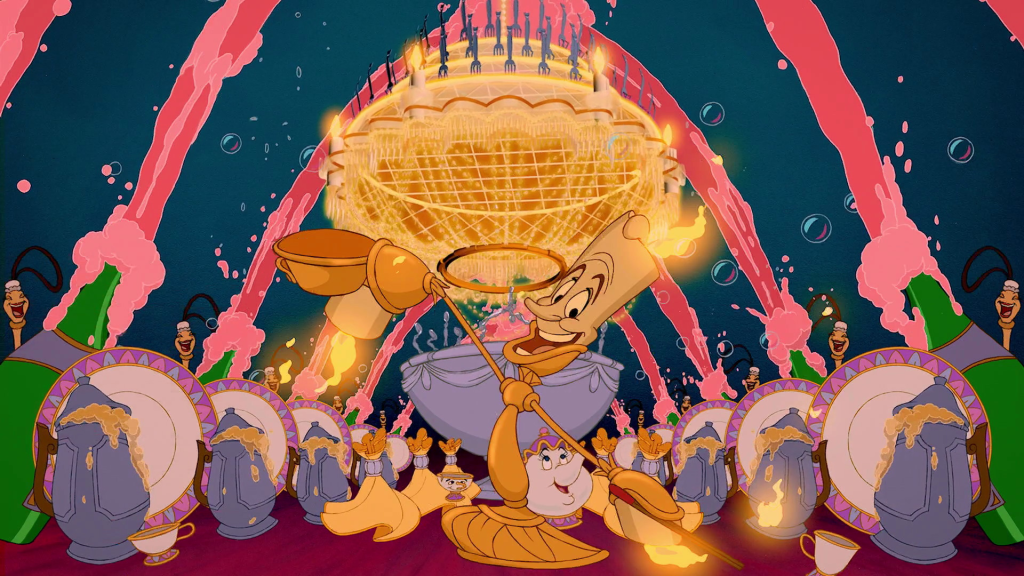
That’s an overwhelming theme of the book – the idea that Hill House itself is alive and menacing. It’s such an interesting take on the haunted house trope. Throughout the book, you find that there are no specific spirits that haunt the house – no apparitions of children, or women carrying umbrellas or ghosts of civil war soldiers that you hear about on ghost tours and on the A&E channel. It’s not about “who” is inhabiting the house, it’s that the house itself is a “who” with an evil persona. Eleanor and the other “guests” have signed themselves up for many nights of entertainment from the enchanted house, and the house has been designed with a perplexing floorplan, and odd angles and passageways to make leaving the house as difficult as possible.
Another famous, enchanted house
Eleanor is joined at Hill House by a beautiful young woman named Theodora (Theo), Dr. Montague, and a member of the family who owns Hill House, Luke Sanderson. When Eleanor arrives at Hill House and meets Theodora, the two of them become fast friends. When the entire crew is assembled, they all seem to be a merry bunch of misfits with a nonchalant attitude toward the house and the events that will inevitably follow in the dark of night. Eleanor is loving being with this group – at this place where she was invited (wanted), with people who seem to enjoy her company – yet, she immediately begins to fear being left out or ostracized for being different.
On the second night of their stay in Hill House, Eleanor and Theo are startled awake by extreme cold in their rooms accompanied by loud banging sounds that come all the way down the hall and culminate with an intense banging and rattling of Eleanor’s bedroom door, along with giggling sounds. Before Eleanor was startled awake, she had been having a dream about her mother calling for her and awoke to this terrifying moment in Hill House with a feeling of relief that her dream was not her reality. Her reality was absolutely horrible and bone-chilling, but served as a welcomed break from the nightmares of her past. The next morning, Eleanor rises with an overwhelming feeling of happiness – happiness in Hill House. This was the moment in the story that I realized the complexity of Eleanor’s character. She lies to her co-habitants about a life in a little apartment with a white cat, she lies about her age, and pretends to be exactly what Theodora wants her to be in hopes that Theodora will continue to want her. She is hyperaware of what every one thinks about her and often misunderstands the things others say to her and misinterprets sarcasm and humor as slights and judgement. When she feels slighted, she feels intense anger and hatred for her new friends, yet still maintains desperation for approval. Eleanor is an extremely fragile and vulnerable character, not quite fully developed as an adult-person. And all she knows is that she is desperate to be wanted and accepted – which makes her a perfect muse for the persona that is the Hill House.
More creepy things happen and Eleanor is soon singled out by the house. The guests find messages written in chalk and blood that say “HELP ELEANOR COME HOME” (in case you need your daily example of why punctuation matters), and tensions among the house guests, particularly Theodora and Eleanor begin to develop. Theodora, who has shown herself to be a pursuant of attention at all costs, accuses Eleanor of writing her own name on the wall, and Eleanor begins to panic that her being singled out will separate her from her group of companions. Over time, however, as Eleanor begins to be sucked in by the house, she revels in the fact that the house chose her over all of the others.
Eleanor begins merging with Hill House, and can hear sounds from all over the structure as if the it were her own body. On the last night of Eleanor’s stay, she finds herself happily running through the halls of Hill House, chasing a voice that keeps telling her to follow (a voice that sounds like her mother’s). She bangs on doors, startling the other guests in their sleep. When they rise and begin to search the house for her, she runs to avoid them and ends up in the library where she climbs a rickety, iron stairway. When the others discover her, they are horrified that she has climbed so high on a stairway that seems weak enough to break from her weight. Luke bravely climbs up the stairwell to usher the disoriented Eleanor down safely. When she is safe on the floor of the library, she realizes that she had not been acting entirely of her own volition, and recalls that she ran happily up that staircase with no thought given to the danger of bodily harm.
Naturally, Luke is quite angry that he nearly broke his neck saving her from her own silly choices, and the entire group tells Eleanor the next morning that she must leave Hill House. Eleanor is devastated by this and does not want to leave. Not because she will miss her new friends, but because she belongs with the house. They force her to get in her car and tell her to drive home, but in the end she decides she will never leave the house and “with what she perceives as quick cleverness” puts her foot down on the gas pedal and drives her car head on into a tree in the yard.
This book was extremely scary to me, but I am in love with it. I am in love with Jackson’s masterful development of Eleanor’s character, and the way most people (especially people who have ever had mental health concerns) can identify with Eleanor. She’s an odd person, and not even a particularly “good” person – she lies, she is spiteful, she is selfish. None of the characters in this book are particularly good. Sometimes they are all great, caring companions who take care of each other in adversity. In other moments, they make fun of Eleanor and revel in making her feel like an outcast. Theo and Eleanor get into heated arguments, but in the end, they always find ways to mend the relationship. None of them are perfect, and none of them are perfectly horrible. But at the end, when Eleanor has been taken in by the house and has seemingly gone insane (demonstrated by her flight up the rickety staircase), the reaction among the group ranges from rage and disgust (demonstrated by Luke) to pity (demonstrated by Dr. Montague) to patronization (demonstrated by Theo). Yet they are all in agreement – they know what’s best for Eleanor and she must leave. It’s such an interesting juxtaposition – they can all accept each other when they are being awful and mean by choice, and can still forgive each other and welcome each other with open arms. But when Eleanor is no longer able to make her own rational choices (either due to mental illness or the house’s power over her, or both) she is cast aside with no regard for what she wants or says she needs. In fact, even though they know she is very unwell, they tell her to drive away from Hill House on her own – none of them accompany her to this implied safety of “home” – further reinforcing her need to find home in the evil arms of Hill House. Of course, the end is disastrous and Eleanor never escapes the clutches of Hill House or the haunting inside of her own head. This seems like interesting commentary on mental illness, right on the heels of the lobotomy era.
Eleanor is a person who is looking for a home, and finds one in the form of vile, diseased, Hill House. As the reader, you never learn what makes things go bump in the night at the house, or why the house is haunted to begin with. Was it haunted when it was built? If not, what event in the house’s long history made it so? Are there spirits walking there, or is the house itself an evil spirit? Will Eleanor haunt the house now that she has killed herself on the grounds? Or was it Eleanor herself who was haunted well before she ever entered the gates of Hill House?
Seriously, I have not done this book justice here. I cannot recommend it enough. I wouldn’t read it right before bedtime, unless you are much braver than I (highly likely).
Her first baby come out sideways. She didn’t scream or nothin’.
October 11, 2021
I never felt as frustrated with my own upper body strength (or lack thereof) than I did when I moved into my house. I was blessed with enough disposable income to hire some guys to come and move my furniture for me, but still stingy enough to insist on moving “anything I can carry myself” on my own, just to save a few bucks on moving costs. I spent days loading up my RAV4 with boxes, driving the 50 minutes from Arlington to Aldie, unloading and then heading back to rinse and repeat. I carried every box up the stairs to where it belonged, and unpacked it myself. The one trip I’ll never forget was the box of books I carried to my office, which I, being the clever girl I am, decided would be on the FOURTH floor. I lost about 5 pounds during the week in August that I moved, mostly from going up and down stairs carrying boxes that I honestly had no business carrying. It’s a miracle that I didn’t hurt myself, pass out from exhaustion, or take a tumble down the stairs. This move has been an ongoing struggle between me and my body. Even last week when I gave my office a little attention and turned it into the workspace of my dreams, I ordered a new desk and chair for the space. I barely got the boxes of furniture from the front stoop to the inside of my house – I think I lost about half of my hit points in that battle. Yet, being the hard-headed woman I am, I still set my sights on getting them up to the fourth floor on my own so Josh wouldn’t have to fool with it on his weekend. Somehow I succeeded, but with much gnarling and gnashing of teeth – and honestly, a lot of frustration heaped onto myself for not being stronger. Why can’t I just be stronger?
Now, I know the answer to that question – my lack of upper body strength could have something to do with me sitting in my bed with Maudie, writing this blog under our blankie, eating the bag of Halloween candy I bought “for my trick-or-treaters” instead of hitting the gym. It also has a lot to do with biology, and the fact that my mother never forced me to eat vegetables or drink milk as a child (yes, Mom, this is all your fault!) resulting in the 5-foot-nothing ball of sass that I am. I am told, however, that there are many other ways to be strong – strong of mind, strong of wit, strong willed, mentally tough, strong in the face of adversity, emotionally strong, strong earring game. I’ve been called each of these at points in my life (most frequently, the earring thing), but I’ve also felt like the opposite of each of these from time to time as well.
One of my least favorite moments of my moving experience was a situation that forced me to face my lack of physical strength and emotional strength head on. It’s such a trivial situation, I feel silly even repeating the story. I had ordered a king-sized mattress for my bedroom, and when it arrived, I discovered that the delivery people were not going to help me get the giant mattress up the stairs. When I handed them a tip and they left, Josh and I stood there with the mattress, each staring up at the stairs we would have to navigate to get it up to the third floor where it belongs. Josh immediately began doing mental calculus – figuring out exactly how the physics would work. And I – well I simply burst into tears. Josh getting that mattress up the stairs with little to no help from me – partly due to my weak body, and partly due to my little melt down, was one of the most impressive feats of ingenuity and strength I’ve ever beheld. Once we got the mattress where it belonged, I hung my head in shame over the strength that I didn’t have.
I love the show “90 Day Fiance”, and on one of the bajillion spin-off’s in the 90 Day universe, I was introduced to a woman named Darcey Silva. Darcey has had her fair share of tribulations in life and especially in love. She spent two seasons of the show with a controlling, 24-year-old (Darcey is in her late 40’s) named Jessie, and two others with a British man named Tom who called her fat. These were obviously not nice guys, and Darcey has earned a bit of a reputation for falling apart and ugly crying on tv. My girl Darcey and her twin sister Stacey are like walking Instagram posts. They indulge in plastic surgery the way I indulge in soft pretzels, and wear really insensible shoes and flashy outfits. They also have little catch-phrases that they repeat to each other, the way people on instagram shout hashtags at each other. #SilvaStrong. #BossBabes. #StrongIndependentWoman. Something goes wrong, and one twin is in the other’s face telling her “Eye on the prize!”, “Out with the old and in with the new!”, “You need to focus on yourself!”, “You’re a strong woman! You have two beautiful daughters!” and so on. I love these women and they make me laugh out loud, but they are perfect examples of how strength is so much more than a hashtag you put below a selfie on social media or a mantra you repeat to yourself over and over again. No matter how often they repeat these words to themselves, they don’t seem to gain much strength from it. They still fall apart on tv all the time, and cut themselves open to fulfill some version of physical perfection that they will never achieve, and are just generally sad people.
Darcey and Stacey, crying through Botox
Telling yourself that you are strong is not the same thing as building that strength by putting the work in. I can pat myself on the back each time I can’t carry a heavy box up the stairs and say “It’s okay, Rebecca, you are still strong!” That’s true. It is okay, and maybe I am strong. But if I want to be strong enough to carry a heavy load, then maybe I can go to the gym and lift weights to work on building that strength. I can tell myself that it’s okay that I burst into tears over a mattress, because everyone gets overwhelmed and reacts in hyperbole. That’s true. It’s also true that I can look at that moment head on, recognize that I was lacking strength in that moment, and find ways to build strength up for next time.
I think about strength a lot. One of my friends was telling me a bit about a depression she is experiencing, and she traced it all back to not feeling strong, which made her feel like she’s not a full person. Then she made this really excellent point about how being in that headspace – feeling weak – put her in a position where she is doomed to fail in a perfect negative-feedback loop. Being the less-than-perfect friend and trusted advisor that I am, my knee-jerk reaction was to tell her that she is strong. #BossBabe. #StrongIndependentWoman. Here’s the thing – those words don’t mean a damn thing if I can’t make her believe them, and they are also not actionable steps she can take toward addressing her problem. What I should have said is that her telling me about this depression and feeling weak was an example of a strength-building exercise she had already done that day. I should have told her that facing her lack of strength head-on, and recognizing the headspace she is in and the effect it has on her is an example of her strength-building. I can liken it to standing in front of the mirror and looking at your biceps and telling yourself “I can work on this” before you pick up the dumbbells. That’s what I should have told her – that it sounds like she’s ready to pick up the dumbbells.
I know strength can mean different things to different people, and I’ve found that strength inside of myself is even open to my own interpretation. I have done my fair share of falling apart and begging people to stay in friendships and relationships, and often I look back at those moments with intense regret for being weak. Other times I can reflect on those same moments and marvel at my willingness to be vulnerable and honest about my feelings – maybe that takes strength too? Maybe it takes strength to even look back at those moments and reflect on them at all – maybe that’s part of the act of strength building – finding out what being strong means to you. There are a lot of strong athletes who can bench press more than their body weight. There are many strong athletes who cannot, because strength means something different to each of them. That’s ok. It’s ok to remind yourself of the strength you have built over your life and celebrate it, but I am more encouraged by the fact that strength is always something we can build and improve upon.
“It’s not that I haven’t been running, I’ve just taken 60 rest days in a row.”
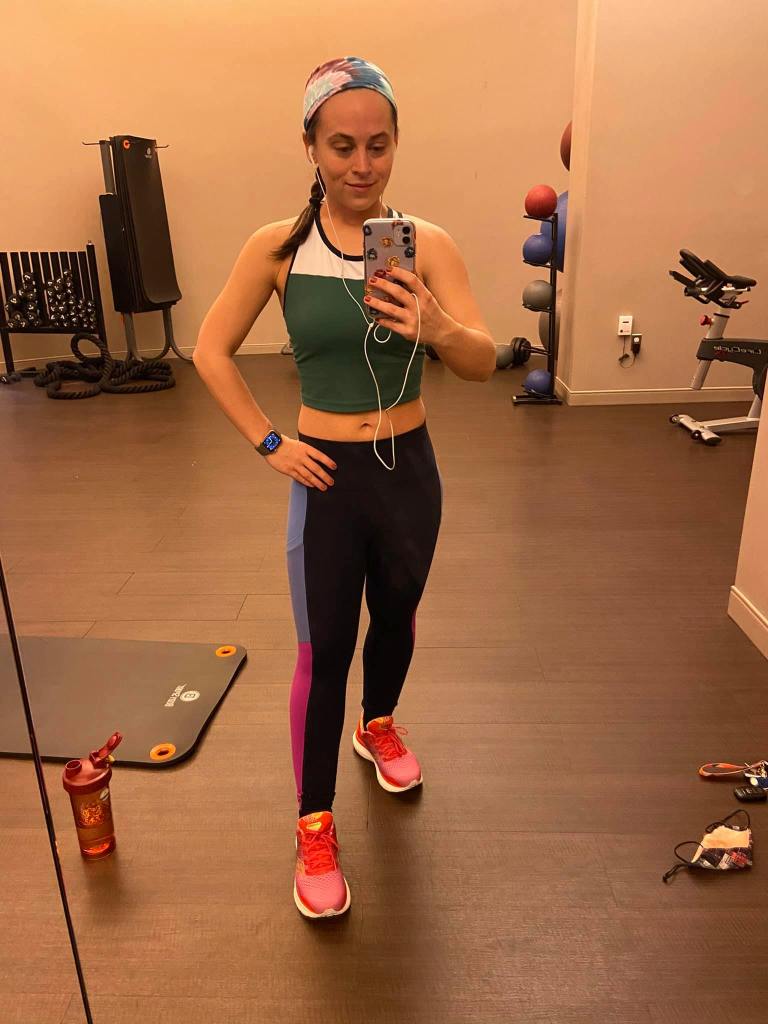
That’s my favorite snarky joke about my running habits, and I think it certainly applies right now. I went for a few morning runs during a rough week in September, but I can’t remember the last time I ran more than two miles – maybe August? July? Who knows. I don’t feel good about this. It’s not that I don’t feel like I don’t get enough exercise – between the StairMaster at my gym and my hikes with the Maudie Dog, I do ok. I don’t even think it has to do with my weight – I’ve found some peace and grace for myself concerning the ~5 pounds I’ve put on my small frame since I went back to work after the shut down. I’m a 31-year-old woman and my body is going to be a 31-year-old body (see my post called ‘Famished’ for more on this topic). When I don’t run, some of the reasons I feel incomplete are less pragmatic than missing the physical benefits of the exercise. I think hitting that pavement day-after-day has become my life’s symbol for strength, mental toughness, fierce friendship and support systems, self-love, perseverance, and independence.
I turned to running for the first time when I was in grad school and I got my heart broken by a Canadian dreamboat. I was lamenting the whole situation to my friend Katie (Katie was a professor at my school, who would later serve as a member of my dissertation committee) and her solution was an invitation to a running club at West Sixth Brewery in downtown Lexington, KY. We ran a couple of miles and then came back to the brewery for beer and soft pretzels. I sat at a table with Katie and her new friend, Shawna – and out of the ashes of one of those atomic bombs of sadness I was talking about in a previous post, a Wolfpack was formed. Katie and Shawna became my two, tiny, twin pillars of strength. We went on countless runs together, stalked each other on the Runkeeper App, and they became my family in Lexington. Years later, on the day I successfully defended my dissertation, I was mentally exhausted and wanted nothing more than to go straight to bed. My Wolfpack refused me my nap, and demanded that we celebrate with a pack run. I’ll never forget when I met them at the UK Arboretum on a beautiful fall day (much like this one) and they handed me a t-shirt that said “Dr. Crouch” on the back, with a statistics joke on the front (‘I like you a lot, but you’re not normal’). Then we ran. I knew that I was loved by these women, and that I loved them, and we all loved to run.
Before the pandemic began last year, I was still in the habit of running, but never more than a few miles at a time. The shut down took my already lonely and closed-off life into a state of implied solitary confinement. I can remember crying myself to sleep at night – feeling like any hope I had of building the community I wanted, like the one I had before I moved to the DC area, was fading with each passing hour of quarantine. How I wished I could go back to warm evening runs and taco parties with my Wolfpack – how I wanted to be in the same room as another person and get a hug from someone who loved me. The only option I had at that time was to love myself. This idea has been cliched in dozens of songs and self-help books, but it’s one of the hardest concepts to turn into actionable steps. The form of self-care I chose first, was my old friend – the pavement. I ordered a new pair of Sauconys from Amazon, and started training like I never had before. Every time the loneliness reduced me to tears, I laced up my shoes. Every time the walls started closing in on me, I put my fanny pack on and hit the trail.
The externalities of time on the trail go so far beyond self-care and time to decompress and think clearly. Calorie deficits result in weight loss and shredding – I’ve never been so close to having abs as I was during the shut down. Intense cardio brings you into a state where you feel like you have the most bad-ass pair of lungs on the planet. It seems odd to say things like “damn my lungs feel good today” but it’s an amazing feeling – you get to the point where you feel like you could run for days if only your knees and feet would cooperate. It made me wish that my lungs were visible to the outside world, so men could be like “dude, did you see the pair of lungs on that chick?!”
As a result of all of the physical changes, confidence builds by default. Knowing for certain that you can basically run as far you want with ease makes you feel powerful and independent- you start to feel like your feet can take you anywhere you want to go. Training alone and completing the race alone is such a test of mental toughness – when I finished my first half marathon all by myself in Old Town, Alexandria, I felt like a wonder. Sometimes on my laziest days when I can’t get motivated to do even simple things like fold laundry or take a shower, I can remember the Saturday I woke up at 5:30 am to run 13.1 miles by myself. Getting faster and stronger every day is intoxicating. Measuring that success with the technology of an Apple Watch or Fitbit, is like having your own personal report card to take home to yourself after every workout. Instant feedback, instant gratification. I also began to use my time running as a tool to battle disordered eating and body dysmorphia. I started running in skimpy clothes and trained myself to not worry about anyone else’s opinion on my body, which helped me start to worry about my opinion on my body a little less. I started noticing my fellow runners on the trail and admiring bodies of all shapes and sizes. These small steps toward redefining the little pathways in my brain that result in thoughts and feelings, were instrumental for my recovery from eating problems and improvement in body image.
I don’t know why I stopped running. I think I got comfortable in my happy life, and busy with my move and work, and frustrated with knees that would ache during every run. I miss running. I miss it the way I miss my Wolfpack, and my best friend and my parents and my sister and her kids. I miss it the way I miss ‘normal’ life. But the thing is, this old friend of mine doesn’t have to be so far away unless I choose for it to be. Today, I went to a running store to get a pair of shoes that will hopefully ease my knee pain. Tonight I laced them up and threw on my old lady compression sleeve and ran two miles – hey, that’s a start. Tomorrow I’ll go a bit further, and I’ll persevere and chip away at my goals one mile at a time. So tonight I’ll raise a glass to my new magic shoes, and I’ll believe that they can take me anywhere.



 Cluelessness is the Mother of Invention